Battle pass - Making a new feature feel like it always belonged
Warhammer: Chaos & Conquest didn't have a battle pass when I joined the project. Designing one meant fitting a major new monetisation feature into a HUD, screen system, and player ritual that had been live for years.
Role
Solo product designer
Timeline
3 weeks · 2025
Tools
Figma, Photoshop
Status
Shipped
The problem
The brief defined a battle pass. It didn't define where it would live.
Chaos & Conquest is a long-running mobile strategy game with a dense HUD, a busy resource bar, and a screen system that players had built habits around for years. The product spec defined the battle pass: tiers, rewards, naming, mechanics. What it didn't define was how any of it fit into a UI that hadn't been built to accommodate it.
The hardest part wasn't designing it. It was finding room for it.
Process
How I got there
01
Understood the Brief
Started with the product spec. Tiers, rewards, mechanics, naming, all defined. My job was figuring out how it would actually look and live in the game.
02
Audited the UI
Audited what each screen actually needed to show and what it didn't. Decided what to keep, what to compress, and what to move so the battle pass could earn its place without crowding the rest.
03
Research & Design
Studied how other mobile strategy games handled battle pass UI, then designed within the existing C&C design system. Borrowed conventions where they served the player, rejected them where they didn't fit the game's tone.
04
Critique
Reviewed with senior designers and refined details for hand-off. The art team produced the final illustration and atmospheric art; my work was the layout, components, and flows.
Key decisions
Three calls that fit the battle pass into the game
01
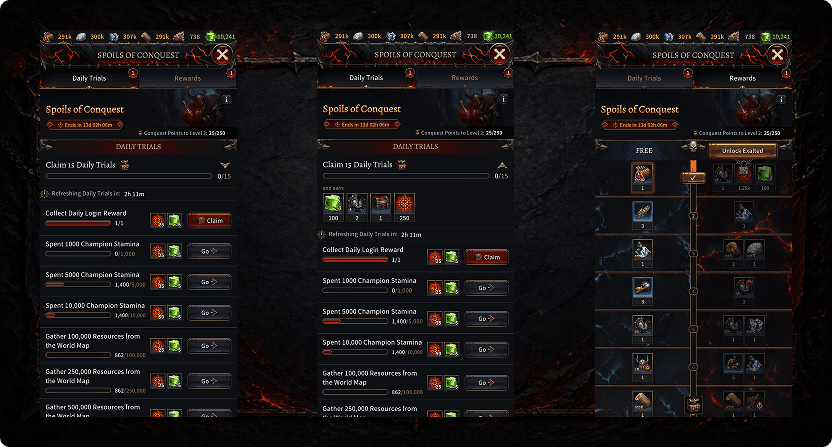
Moved Daily Trials into the Battle Pass
Daily Trials already lived as their own screen. They were also the only way to earn battle pass points, which meant the activity sat in one place and the progression sat in another. I moved them inside the Battle Pass as a tab so both lived in the same screen. Complete trials, earn points, unlock rewards. One loop, one place.
Phone mockup
02
Turned a fixed claim banner into a dropdown
The “Claim 15 Daily Trials” panel used to sit as a permanent header at the top of the screen. It mattered for ten seconds a day and stole space the rest of the time. I collapsed it into a dropdown that auto-expands the moment a claim is ready. The prominence shows up when it matters and disappears when it doesn't.
Phone mockup
03
Added a HUD button without taking from the game
Mobile RTS HUDs are full. Every pixel already has a job. Adding a battle pass entry meant finding a slot that felt obvious without making players relearn the interface they already knew.
Phone mockup
04
Made progress easy to find in a long list
A battle pass is a long, vertical list. Without help, players open it at the top and scroll to find where they are. The screen now opens scrolled to the player's current tier, so the answer to “where am I?” is the first thing you see. The chest button in the header acts as a smart jump: tap it once to skip to the final reward, tap again to come back. Two taps to see the full arc instead of a thumb workout.
Phone mockup
Final designs
Where it landed
Outcome
What I learned
This was an early project for me, and it's still the one I learned the most from. Working from someone else's spec, inside someone else's game, on someone else's design system, I learned that good design in a live product is rarely about invention. It's about finding the smallest set of changes that make a new feature feel like it always belonged. The dropdown, the tab restructure, the HUD slot. None of those were exciting on their own, but together they made the Battle Pass feel native rather than bolted on.
There was no user testing on this project. The team's process leaned on real player behaviour after launch rather than testing in advance. The decisions in this case study are backed by design reasoning and senior critique, not user data. If I picked up a feature this big again, I'd make the case for a testing round before launch.